
Lighting Blog
How to Select the Best Waterproof Moving Head Lights for Theme Parks

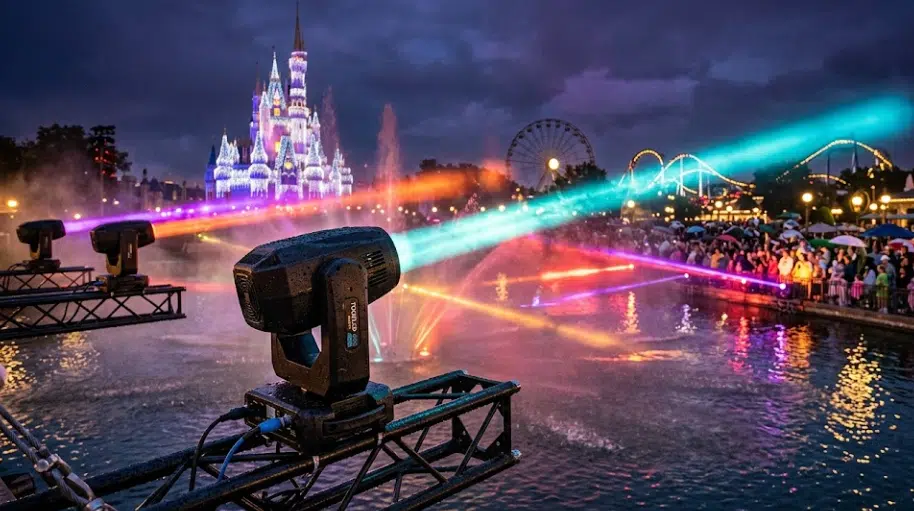
High-grade waterproof moving head lights serve as standard equipment for large outdoor cultural tourism projects, light shows and theme park night tours.
These outdoor fixtures operate year-round under harsh conditions including torrential rain, extreme heat and persistent high humidity, hence strict IP protection standards are mandatory. Water ingress frequently triggers equipment breakdowns that interrupt live performances while generating exorbitant aerial maintenance labour and equipment rental expenses.
For B2B buyers and engineering contractors, pricing and wattage are secondary evaluation metrics when sourcing waterproof moving head lights for theme parks. IP ratings and industrial quality control standards take top priority. Below are four core technical dimensions to screen qualified fixtures rigorously, with reference to 2026 Bulk Purchasing Guide for Moving Head Lights for cross-scenario procurement standards.
1. IP Rating Is Not the Sole Judgement Criterion
Numerous purchasers hold a misconception that IP65 marking equals full waterproof performance adequate for theme park use, yet this classification alone cannot meet rigorous outdoor operational demands.
- Enhanced IP66 protection: IP65 only withstands low-pressure water jets. IP66-rated units are the optimal pick for water parks, high-pressure water splash zones and areas prone to heavy downpours.
- C5M marine anti-corrosion coating: Coastal resort theme parks are filled with salt-laden mist. Die-cast aluminium lamp housings must pass ISO 12944 C5M heavy corrosion testing and feature UV-resistant fluorocarbon paint finishes, as outlined in professional outdoor lighting manufacturing guidelines China Stage Lighting Manufacturing Hubs Guide.
- Dual-chamber anti-fog design with breathable Gore valves: High-power LED fixtures generate internal air expansion and contraction during operation. Premium park-grade lights adopt physically separated optical and power cavities paired with waterproof breathable valves to balance internal air pressure and eliminate lens fogging.
2. Long-Distance Signal Transmission Stability
Theme parks cover vast territories, often placing control rooms hundreds of metres away from outdoor lighting trusses, with heavy EMI interference from roller coasters and massive LED display screens.
- Main backbone communication protocol: Replace legacy Art-Net broadcast systems with waterproof moving heads supporting sACN (E1.31) multicast transmission architecture. Learn foundational signal transmission logic from DMX512 Full Guide.
- Fibre optic relay & network decoding infrastructure: Transmit control signals via single-mode fibre to outdoor waterproof switches in separate park zones, then convert network signals to standard DMX512 output through dedicated signal nodes.
- Galvanic isolation hardware protection: Install optically isolated DMX splitters upstream of each fixture daisy chain to block electrical surges and signal distortion.
3. Public Safety & Mechanical Structural Specifications
- Wind load third-party testing: Overhead installations on castle spires and elevated trusses endure powerful wind shear. Manufacturers must provide certified wind load analysis reports proving lamp bodies, mounting clamps and internal motor gear brakes resist structural deformation under strong winds.
- Dual anti-fall safety compliance: Every fixture requires an independent anchor point for safety lanyards. Stainless steel UV-coated safety cables with a minimum 10:1 safety factor are compulsory alongside primary mounting clamps.
- Global safety certification verification: Inspect units for ETL/UL 1573, CE and RoHS accreditations plus official third-party test reports. For mechanical fault troubleshooting reference, see Moving Head Error Code Troubleshooting.
4. Full Lifespan Total Cost of Ownership (TCO) Comparison Table
| Evaluation Item | Low-Grade Retrofit Waterproof Lights | Professional Theme Park-Grade Waterproof Moving Heads |
|---|---|---|
| Light Source & Service Life | Conventional gas discharge lamps (1,000–2,000-hour replacement cycle) | High-power white LED engine (>50,000-hour lifespan) |
| Maintenance Frequency | Frequent disassembly, dehumidification and worn gasket replacement | Minimal upkeep with closed-loop self-balancing ventilation |
| Hidden Operating Expenses | Costly aerial work platform rentals and mandatory performance shutdowns for repairs | Near-zero seasonal maintenance overhead |
| Remote Diagnostic Support | Basic DMX feedback only or no remote monitoring | Full bidirectional RDM support; real-time centralised monitoring of internal humidity, LED junction temperature and motor error logs |
💡 Core Sourcing Principle
Prioritize premium fixtures integrated with LED light engines, continuous CMY colour mixing and wide zoom ranges to reduce total truss-mounted quantities. Avoid bulk cheap units lacking RDM feedback and C5M anti-corrosion coating merely to fill rig capacity.
For versatile indoor hybrid fixture references, review 3-in-1 Moving Head Complete Guide; compact small-power beam models are available at 60W Mini Beam Moving Head and mid-size spot units at 150W High CRI Spot Light, while zoom wash fixtures can be viewed at 19×15W Zoom Wash Moving Head. EDM outdoor high-power beam design tips are covered in EDM Stage Beam Lighting Guide. Global industry exhibition schedules for on-site product testing are listed at 2026 Stage Lighting Exhibition Calendar.
Frequently Asked Questions: Waterproof Moving Head Lights for Theme Parks
Q1: What are waterproof moving head lights for theme parks?
A: Industrial outdoor fixtures engineered exclusively for theme parks, water parks, outdoor cultural tourism and fountain live shows, equipped with integrated dust and water ingress protection.
Q2: How to select suitable IP ratings for theme park lighting?
A: IP65 serves as the baseline for walkways and open-air performance stages. IP66 or IP67 is mandatory for lakeside, fountain and water splash zones. Standard indoor IP20 moving heads cannot operate outdoors.
Q3: What wattage tiers match different theme park scenarios?
- 230W–275W IP65: Small landscape nodes and pathway ambient lighting
- 350W–380W IP65: Core scenic zones and outdoor performance stages
- 440W–470W IP65: Large plaza night shows and landmark facade projection
- High-power IP66 beam moving heads: Lake fountain and water curtain light displays
Q4: Can waterproof moving heads withstand extreme temperatures, rain and direct sunlight?
A: Qualified IP65 fixtures operate stably between -30°C and 45°C under rainy, snowy and coastal salt-laden conditions. Sun visors are recommended for long-term direct solar exposure.
Q5: Why is anti-fogging functionality critical for outdoor moving heads?
A: Day-night temperature fluctuations trigger internal lens condensation, blurring light output and ruining visual effects.
Q6: What anti-corrosion standards apply to seaside theme park lighting?
A: Select fixtures with marine-grade salt-spray resistant coatings, and clean lamp housings plus cable connection joints every three months to prevent salt deposit buildup.
Q7: What safety rules govern overhead rigging of park waterproof moving heads?
A: Mount units on stainless steel trussing paired with rust-proof safety lanyards and waterproof junction boxes. Dual anti-drop latches are required for any rigging positioned above pedestrian zones.
Q8: How to route outdoor power and DMX signal cables?
A: Deploy outdoor waterproof shielded cabling inside buried PVC conduits; enclose all wire junctions within waterproof terminal boxes and never overload fixture daisy chains.
Q9: What is the routine maintenance cycle for permanently installed waterproof moving heads?
- Monthly: Wipe exterior dust and inspect lenses for internal fogging
- Quarterly: Examine waterproof gaskets, dehumidification modules and housing corrosion
- Bi-annually: Complete internal dust removal and lubricate X/Y axis drive gears
- Annually: Full inspection of light engines, power supplies and overall waterproof integrity
Q10: Can IP65 waterproof lights be fully submerged in water?
A: IP65 only resists splashing rainwater and does not support full submersion. IP67 submersible models are required for underwater fountain installation.
Q11: What risks come with uncertified low-grade outdoor lighting?
A: Water ingress causes electric leakage endangering visitors; fogged lenses render lighting ineffective; corroded mounting brackets risk catastrophic fixture falls from height.
Q12: Do open-air theme parks require additional lightning protection?
A: Lightning arresters must be fitted to overhead trussing and main power distribution cabinets for large uncovered park zones to shield fixtures from surge damage.
Reference:
[1] IEC 60529, Degrees of Protection Provided by Enclosures (IP Code)
[2] ISO 12944, Paints and Varnishes – Corrosion Protection of Steel Structures by Paint Systems
[3] PLASA Technical Standard, RDM & Outdoor Moving Head Optical Chamber Design Best Practices
[4] USITT RP-2, Wind Load & Overhead Rigging Safety Specifications for Stage Fixtures
[5] ANSI E1.11 / UL 1573, Safety Standard for Entertainment Stage Lighting Equipment
About the Author:
Eason (Yifan) Chen
Stage Lighting Expert & Digital Strategist
With 15+ years of industry expertise, Eason Chen is a leading authority in stage lighting and digital manufacturing. A technical contributor at Prolight + Sound and LDI, he specializes in bridging the gap between cutting-edge energy protocols and commercial ROI.