
Lighting Blog
Stage Moving Head Light Safety Operation Specifications & Risk Prevention

1. Power & Electrical Safety – Non-Negotiable Rules Before Power-Up
Strict power cut protocol:
Always disconnect the AC mains supply before disassembly, lamp replacement, fuse changes or servicing any internal components. Unplug the unit fully if it will remain unused for extended periods.
Reliable earthing:
The fixture’s protective earth wire must be securely grounded. Only connect to compliant local AC power supplies equipped with overload and earth fault protection.
No bypassing safety components:
Never short-circuit or bridge thermal cutoffs and fuses. If a fuse blows, replace it solely with an identical matching rating; copper wire or any other makeshift conductor is forbidden.
Waterproof and moisture precautions: Standard indoor moving heads contain high-voltage circuitry and must never be exposed to rain or humid environments (excluding IP-rated outdoor waterproof models).Learn professional outdoor lighting protection via outdoor moving head procurement guide.
💡 Practical Tip:
Keep a voltage tester or multimeter on hand. After wiring all fixtures to the distribution box for large-scale shows, test voltage and earthing integrity before powering on any moving heads.Master basic signal transmission logic from DMX512 complete tutorial.
2. Rigging, Transportation & Fall Prevention – High-Altitude Work Safety
No solo heavy handling:
Fixtures are bulky with unstable centre of gravity. Never attempt lifting or moving one alone; all loading and unloading requires two-person teamwork to prevent crushing injuries or strains.You can find venue rigging schemes in club lighting configuration guide.
10x load capacity rule:
Rigging trusses and support structures must withstand a minimum load of ten times the total weight of all suspended lighting units.For industrial truss and fixture sourcing, check stage light manufacturing hubs guide.If your fixture suffers overheating or motor reset failures, troubleshoot with moving head error code guide.
Dual safety backup:
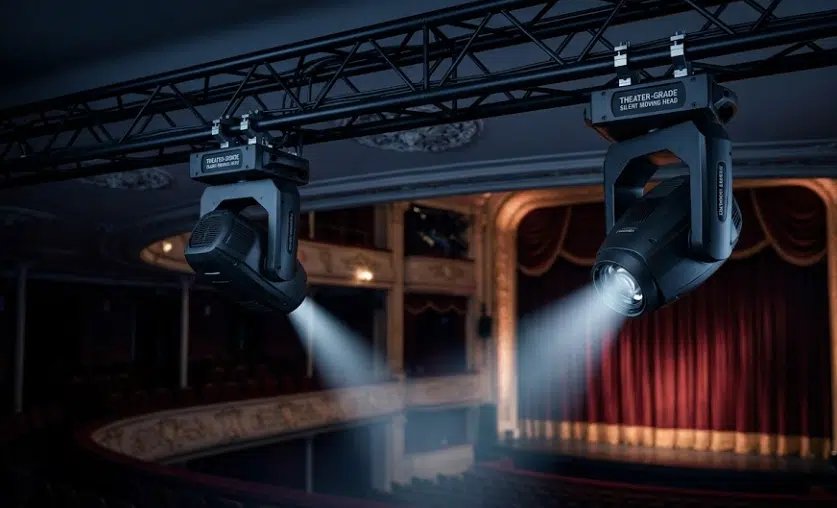
Ensure all outer covers, quick-release clamps and mounting hardware are fully tightened. Every suspended fixture must be fitted with a certified safety cable anchored to a separate structural beam, not the same truss arm as the main clamp.
Restricted ground zones:
Erect physical barrier tape underneath all rigging work zones during installation or teardown to block unauthorised personnel and eliminate risks from falling debris.
3. Fire Prevention, Heat Dissipation & Clearance Distances – Operating Spatial Requirements
1-metre fire separation:
Maintain a minimum 1-metre gap between active fixtures and all combustible materials including stage drapes, timber, paper and props. Do not store flammable substances near the lighting rig.
1-metre projection clearance: Keep illuminated surfaces such as stage floors and backdrops at least 1 metre away from the fixture’s lens output to avoid surface scorching or ignition.
10-centimetre ventilation gap:
Leave a minimum 0.1 m of unobstructed space around cooling fans and air vents; never block intake or exhaust openings.
Unobstructed lens aperture:
Remove all coverings including black cloth, paper and protective caps before powering the unit on.
Ambient temperature limit:
Do not operate the fixture if the surrounding air temperature exceeds 40°C.
4. Lamp Maintenance & Radiation Protection – Care for Core Components
UV radiation and explosion hazard prevention:
Active gas discharge lamps emit powerful ultraviolet light and hold high internal pressure. Never look directly at a lit lamp, and never run the fixture with missing or damaged lens housings or outer casings.
15-minute cooling rule:
Allow the fixture to cool for at least 15 minutes before opening the housing to replace the lamp.
Mandatory PPE:
Wear protective gloves and safety goggles when handling lamps. Gloves prevent skin oil residue from contaminating the bulb surface – oil buildup causes uneven heating and catastrophic lamp rupture when powered.
Timely lamp retirement policy:
Replace lamps immediately if blackening, deformation, failed ignition occurs, or once they reach or exceed the manufacturer’s rated service life.Browse all standard fixture models at stage lighting product page.
5. Unauthorised Modifications & Routine Handling – Standardised Equipment Management
5-minute cool-down before handling:
Fixture casings remain dangerously hot post-show or testing. Allow a minimum 5-minute cooling window prior to disassembly, packing or transport.
No unapproved structural or circuit alterations:
Do not modify internal wiring or fixture framing, and avoid third-party non-OEM replacement parts. Uncertified custom modifications create severe fire and electrical failure risks.
📋 Daily Rig & Teardown Safety Checklist
| Stage | Inspection Item | Completed Check |
|---|---|---|
| Rigging Setup | Barrier tape installed beneath suspended lights | ☐ Confirmed |
| Quick clamps locked, safety cables secured & anchored | ☐ Confirmed | |
| Minimum 1m clearance maintained from drapes and surfaces | ☐ Confirmed | |
| Pre-Power-Up | Earth wire securely connected; distribution box voltage stable | ☐ Confirmed |
| No plastic bags, dust cloths or obstructions covering air vents | ☐ Confirmed | |
| Teardown | Main AC power fully disconnected | ☐ Confirmed |
| Fixtures cooled for more than 5 minutes before handling | ☐ Confirmed |
Supplementary Industry Reading
- Learn 2026 mainstream stage lighting trends: 4 Major Stage Lighting Trends 2026
- EDM festival beam light design skills: EDM Stage Lighting Design Guide
- DJ venue color matching techniques: DJ Lighting Color Scheme Guide
- Global stage lighting exhibition schedule: 2026 Lighting Expo Calendar
- Guangzhou PLSG sourcing exhibition intro: PLSG 2026 Exhibition Guide
- AI intelligent lighting technology analysis: AI Stage Lighting Intelligence Trends
References:
- ESTA (Entertainment Services and Technology Association) & ANSI Standards:
- ANSI E1.21-2022: Entertainment Technology — Temporary Structures Used for Technical Production of Outdoor Entertainment Events. (Governs safe rigging, structural loads, and environmental precautions for outdoor structures).
- ANSI E1.4-1-2022: Entertainment Technology — Manual Counterweight Rigging Systems. (Provides safety criteria for general rigging practices and load considerations).
- PLASA (Professional Lighting and Sound Association) Guidelines:
- PLASA Code of Conduct for Rigging: Outlines international safety factors (including the $10\times$ safety factor guideline used for critical non-redundant rigging elements) and double-backup protocols using safety bonds/cables.
- NFPA (National Fire Protection Association) Codes:
- NFPA 70: National Electrical Code (NEC) – Article 520: Theaters, Motion Picture and Television Studios, and Similar Locations. (Sets the legal mandate for mandatory grounding/earthing, overcurrent/overload protection, and safe power distribution for stage lighting equipment).
- NFPA 101: Life Safety Code: Specifically sections addressing flame-propagation, clearance distances between high-heat performance equipment (moving heads), and combustible stage draperies/scenery.
- Institution of Engineering and Technology (IET):
- Code of Practice for In-service Inspection and Testing of Electrical Equipment (PAT Testing): Establishes protocols for routine insulation, earthing integrity tests, and the mandatory use of multimeters/testers prior to energizing portable stage distribution systems.
- OSHA (Occupational Safety and Health Administration) Regulations:
- 29 CFR 1910.303: General Electrical Safety Requirements (Covers the prohibition of bypassing fuses or modifying certified NRTL/OEM equipment).
- 29 CFR 1926.501: Duty to Have Fall Protection (Governs dropping hazards, setting up controlled access zones/barrier tape underneath high-altitude work areas).
About the Author:
Eason (Yifan) Chen
Stage Lighting Expert & Digital Strategist
With 15+ years of industry expertise, Eason Chen is a leading authority in stage lighting and digital manufacturing. A technical contributor at Prolight + Sound and LDI, he specializes in bridging the gap between cutting-edge energy protocols and commercial ROI.