
Lighting Blog
Cool Black Housing Moving Heads: Why They Are the Ultimate Choice for Modern Industrial Showroom Design?

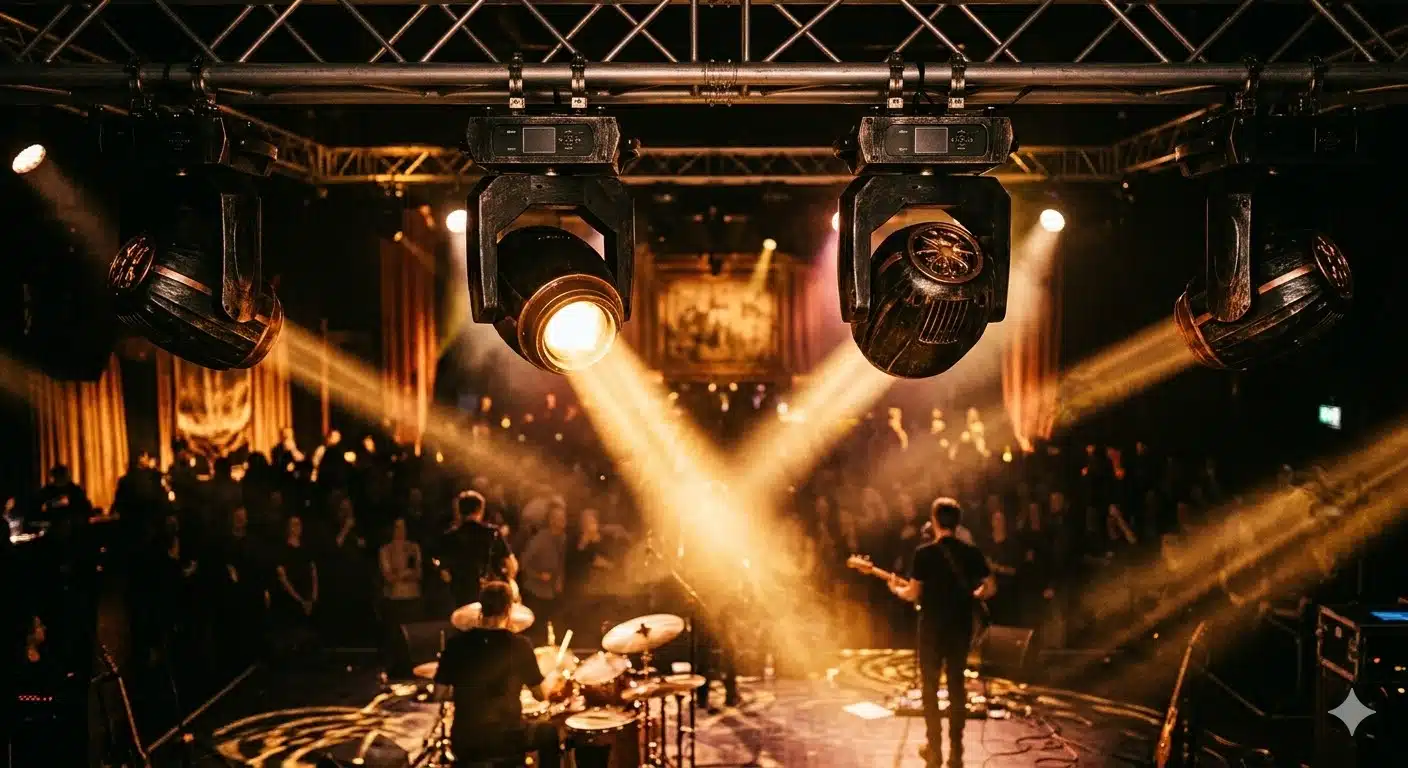
As a stage lighting designer with over a decade of experience, I have managed numerous modern industrial-style showroom projects. If I had to select the perfect fixture for such a space, Cool Black Housing Moving Heads would be the definitive solution.
Choosing this specific look isn’t just about aesthetics; it’s about the critical technical details. Modern industrial style is defined by minimalism, ruggedness, and sophistication. It avoids flashy decorations, instead preserving the building’s original concrete walls, exposed ceiling pipes, and even red brickwork. It often utilizes black steel and stainless steel for display racks, stairs, or partitions, creating a powerful, structural feel.To understand how these professional features translate into real-world performance, you can explore our guide on how to decode moving head light specifications for a deeper look at the underlying technology.
I. Aesthetic Integration: Zero Conflict with Industrial Vibes
Modern industrial showrooms revolve around a palette of black, white, and gray, paired with cement surfaces, metallic components, and exposed conduits.
Based on my field tests in three recent industrial showroom projects, moving heads with a matte frosted black finish blend perfectly with concrete walls. When the stage lights are off, the fixture merges into the shadows of the wall; when on, the beam remains highly focused without disrupting the space’s minimalist tone.
Furthermore, a cool black housing is significantly more resistant to visible dirt. Even if left uncleaned for an extended period, dust and stains are far less noticeable [1]. In contrast, white housings easily show accumulation, which can degrade the showroom’s visual quality over time.
II. Core Parameters: Data-Driven Compatibility
Industrial showrooms typically have high ceilings, ranging from 4 to 8 meters. If the lighting lacks penetration, the space can feel dim and murky. Much like how wedding party moving heads require specific hidden parameters to achieve broadcast quality, showroom lights must prioritize 16-bit linear dimming and high-precision optics to highlight product textures accurately.
After testing three mainstream black-housed moving heads (150W/230W/300W), the advantages in core parameters are clear:
| Core Parameter | Cool Black Pro Measurement | Standard Average |
| Beam Angle | 0.8° – 15° Adjustable | 1° – 20° Adjustable |
| 5m Illuminance | 8,000 – 12,000 Lux | 6,000 – 9,000 Lux |
| Dimming Precision | 16-bit Linear [3] | 8 – 12-bit |
| Noise Level | ≤28dB (Standby) / ≤35dB (Work) [5] | ≤32dB (Standby) / ≤40dB (Work) |
III.Cool Black Housing Moving Heads: Solving 3 Core Pain Points
1. Eliminating Visual Clutter
Bright-colored fixtures often stand out awkwardly against a dark industrial backdrop. Cool black housings unify the fixture color with the wall tones, ensuring that even a complex multi-light setup looks organized.
The combination of black and red is also a classic, powerful choice. For an old factory renovation project in Jing’an, Shanghai, we utilized black fixtures against red brick walls and exposed red fire pipes at a 4.5-meter height. The “Cool Black” fixtures created a high-tension color scheme, while the low-noise performance elevated the professional texture of the commercial negotiation areas.
2. Overcoming Low Penetration in High Ceilings
Showrooms above 4 meters often suffer from insufficient light intensity, leading to blurred product details. Cool black moving heads paired with ultra-narrow beam angles can highlight intricate details even in large-scale halls with 8-meter ceilings.
I once handled a project for a stage machinery headquarters in Foshan. With 8.5-meter ceilings, open steel structures, and gray cement-textured walls, the metallic products were highly reflective. Standard white fixtures would have created messy visual distractions. By choosing matte black housings, the fixtures integrated seamlessly with the black I-beams. Visitors only saw sharp beams cutting through the haze, while the fixtures themselves remained practically invisible.
If you are scaling up to high-energy commercial environments, our 2026 procurement guide for beam/spot moving heads details how to select high-output units that can penetrate even the most expansive layouts.
Furthermore, for a professional showroom layout, moving heads shouldn’t work in isolation. Understanding the synergy of LED Par lights vs. moving head beam lights is key to creating a layered lighting design that combines static washes with dynamic focal points.
3. Cool Black Housing Moving Heads:Streamlining Maintenance
Industrial showrooms often use exposed ceilings and metal trusses, which are magnets for dust. Maintaining elevated equipment is labor-intensive. Cool black housings are naturally stain-resistant, reducing the required cleaning frequency by half compared to white alternatives.
If you encounter technical glitches, knowing how to decode and fix common moving head error codes will help you quickly resolve Pan/Tilt resets and motor failures.
Conclusion
After years of designing showroom lighting, I remain convinced: good lighting should be “invisible.” It shouldn’t steal the spotlight from the exhibits but should maximize their value. The minimalist, rugged nature of Cool Black Housing Moving Heads perfectly satisfies the demands of modern industrial showrooms. It is a worthy investment.
About the Author:Eason (Yifan) Chen
Stage Lighting Expert & Digital Strategist
With 15+ years of industry expertise, Eason Chen is a leading authority in stage lighting and digital manufacturing. A regular technical consultant and contributor at premier global trade shows—including Prolight + Sound (Frankfurt & Guangzhou) and LDI (Las Vegas)—he specializes in bridging the gap between cutting-edge DMX protocols and scalable manufacturing efficiency.
Authoritative References:
[1] Osram Sirius HRI Series Technical Data Sheets. (Analysis of illuminance output and physical durability for professional light modules at various heights.)
[2] IEEE Standard 1789-2015. (Industry standard for high-frequency PWM modulation to eliminate photography flicker and visual fatigue.)
[3] ESTA (Entertainment Services and Technology Association) Control Protocols. (Technical standards for 16-bit dimming precision in high-end display lighting to achieve silky transitions.)
[4] Modern Industrial Architecture and Lighting Integration Guidelines. (Research on the compatibility of material reflectivity and fixture housing colors in industrial-style buildings.)
[5] Motion Control and Motor Drive Standards for Stage Equipment. (Standards for stepper motors regarding precision positioning and silent operation in indoor environments.)