
Lighting Blog
How to Choose High-Brightness Silent Moving Head Lights for Indoor Weddings?

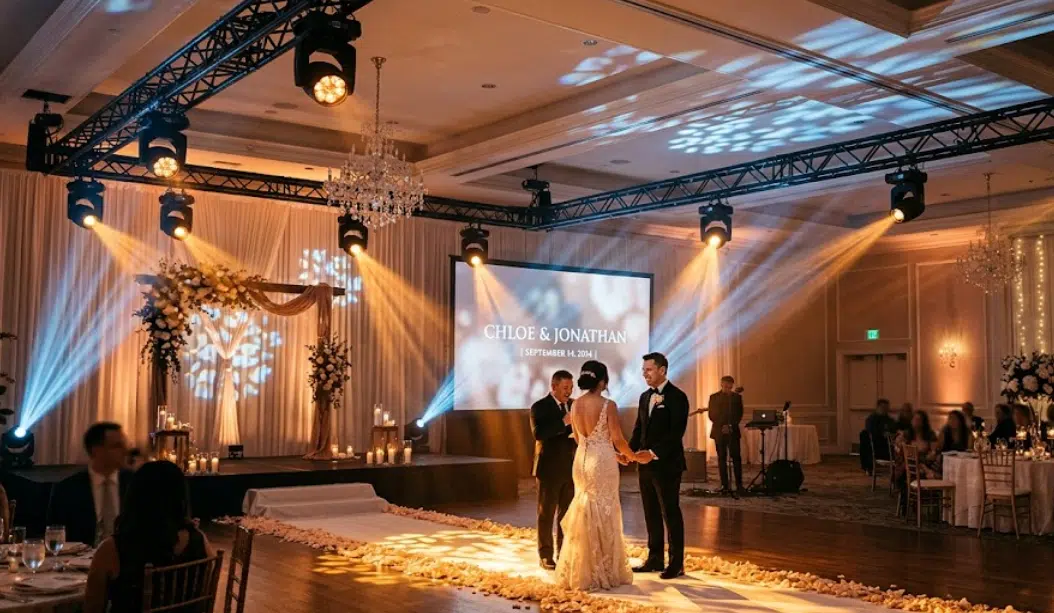
Many people ask me what a perfect indoor wedding looks like. My answer: It’s not about how expensive the flowers are, but how the light falls upon the scene.
Finding the right lighting feel indoors is all about balancing three variables: brightness, silence, and refinement. I often joke with colleagues that choosing the right lights leads to a “highlight moment,” while choosing the wrong ones leads to a “photography disaster.” To avoid these mistakes, many professionals now refer to the Common Pitfalls in Stage Lighting Procurement for 2026 to ensure their investments hold up over time.
Imagine the most pivotal moment—the lights dim, the music fades, and all eyes are on the couple. This should be a heartfelt vow exchange full of emotion, but instead, the room is filled with the roar of cooling fans. In that instant, the warm atmosphere is shattered.
To preserve those precious moments, I’d like to share my perspective as a veteran lighting engineer on how to choose high-brightness silent moving head lights for indoor weddings.
1. Why Prioritize Silent Performance for Indoor Weddings?
As previously mentioned: a good wedding moving head should feature an excellent cooling system or a “Silent Mode.” When operating at low power, noise levels should be as low as possible.
The most awkward scene I’ve witnessed involved a groom saying “I do” while cheap moving heads overhead hummed like old desktop computers. If the noise exceeds 45dB, the vows in the wedding video might be drowned out by fan noise. Understanding the 5 Essential Technical Parameters for Professional Stage Lighting is vital for any indoor installation where acoustics matter as much as visuals.
If the noise exceeds 45dB, the vows in the wedding video might be drowned out by fan noise during post-production. According to ANSI recommendations for indoor performance spaces, a high-quality silent mode should control noise at approximately 25–30dB [1]. Understanding these 5 Essential Technical Parameters for Professional Stage Lighting is vital for any indoor installation where acoustics matter as much as visuals.
Pro Tip:
Prioritize models like the DJClub Mini 230W Ultra Bright, which are explicitly labeled with “Silent Operation.” These have optimized internal air ducts to ensure no background noise interferes with vow recordings.
2. Indoor Weddings: 230W or 400W?
For indoor weddings, higher power isn’t always better. Your choice should depend primarily on the ceiling height.
Standard Ballrooms (Height 12–20 ft / 4–6m):
A 230W (7R) beam light is ideal. Its beam remains sharp within 10 meters, and its compact size is safe for the weight-sensitive light trusses found in many hotels. Interestingly, 230W stage lights with double prism effects have also become a staple for after-party nightclub transitions due to their versatility.
Grand Ballrooms or Industrial Spaces (Height 25ft+):
Consider 400W LED fixtures. While high power is often associated with UL-listed investments for large venues, in a wedding context, LED lights offer a CRI of 90+ and smoother dimming. rust me, in photos, the white texture of a high-end wedding dress looks far more sophisticated under LED than under the slightly greenish tint of traditional bulbs.
3. Optical Effects: The Secret to a “High-End” Look
Nothing is worse than harsh, static white light at a wedding. Indoor spaces are limited, so they require dreamy textures to enhance the mood.
When preparing for an indoor wedding, always choose lights with a Rotating Gobo function. During the processional, I like to project petal textures along the aisle. As the bride walks through the shifting light and shadow, it creates a sense of sanctity that static decorations cannot provide.
For the First Dance, I layer on an 8-facet or 16-facet prism. This creates the effect of a brilliant flower blooming in the center of the stage—the kind of moment that makes every guest pull out their phone to share on TikTok. After the ceremony, I switch to Wash Mode with one click to create a romantic, color-drenched party atmosphere. This aligns with the top 4 stage lighting trends for 2026, which emphasize spatial design and intelligent control to create more immersive emotional experiences.
4. Key Parameter Reference Table
| Dimension | Recommended Configuration | Reason |
| Light Source | 230W 7R (Strong beam) or 300W+ LED (Smooth dimming) | Meets illuminance needs for indoor short-to-medium distances. |
| Cooling Mode | Temperature-controlled axial fans | Automatically reduces noise during ceremonies to protect audio recording. |
| Control Protocol | DMX512 (16+ channels) | The trend toward AI creation makes precise DMX control more important than ever. |
| Zoom/Focus | Motorized linear focus | Ensures sharp gobo edges at various distances, avoiding “blur.” |
| Portability | Weight < 15kg (Mini models) | Easy for transitions; low pressure on lightweight trusses. [3] |
5. Procurement Guide for Indoor Wedding Stage Lighting
To stay organized, I recommend following a 2026 professional lighting equipment checklist. Many of the world’s most reliable fixtures are sourced directly from China’s manufacturing heartland; you can learn more about Why Foshan is the Global Hub for Professional Stage Lighting to better understand the quality behind the tech.
| Fixture Type | Recommended Qty | Core Role | Buying Red Flag (Key Tip) |
| Silent Moving Head | 4 – 8 units | Ceremony beams, textures | Must have CTO filters, or the couple’s faces will look pale/green. |
| LED Zoom Wash | 8 – 12 units | Room washing, face fill | Dimming must be buttery smooth; avoid “flickery” cheap units. |
| Wireless Up-lights | 12 – 20 units | Wall lighting, depth | Must be battery-powered to avoid tripping guests with cables. |
| LED Par Lights | 6 – 10 units | Detail fill, background wash | CRI > 90, otherwise photographers will despair. |
| Leko (Spotlight) | 2 – 4 units | Precision key light, face lighting | Clean shutters; light the face only, not the screens. |
6. FAQ: Moving Heads for Indoor Weddings
What is the purpose of moving heads?
To create atmosphere, focus on the couple, brighten the stage, and elevate the “premium” feel.
How many do I need?
4–8 for small weddings; 8–12 for medium to large ones, depending on venue size and budget.
Will they be blinding?
No. Professional lighting designers control angles and modes to avoid direct eye contact with guests.
What if the ceiling is low?
Use short-throw moving heads; they can be hung lower or placed directly on the floor.
Do they consume a lot of power?
Power consumption is moderate. For a short wedding duration, it won’t impact the venue’s electrical capacity.
Can they match my wedding colors?
Yes, they support multiple colors, patterns, and beam switches to adapt to any wedding palette.
Is pre-wedding testing required?
Absolutely. Programming and positioning should be finalized during the rehearsal.
Floor-mounted or truss-mounted?
Hanging from a truss is preferred for better light/shadow effects; otherwise, floor stands are fine.
Moving Heads vs. Par Lights?
Pars provide overall wash/color; Moving Heads provide beams, patterns, and spot focus. They work best in tandem.
What if I have an outdoor ceremony?
Indoor lights aren’t built for weather; you’ll need all-weather IP66 moving heads designed for festivals and outdoor events.
Final Procurement Advice
LED or Bulb? If you move from venue to venue frequently, LED is more durable, has a longer lifespan, and eliminates the worry of a bulb exploding mid-event. If you want to see these technologies in person before buying, check out the 2026 Global Stage Lighting Exhibition Calendar to find a show near you.
Additionally, avoid “Cold White” at all costs—it makes a wedding look like a serious office. Ensure your wedding lights include CTO (Color Temperature Orange) correction, which can turn a harsh white into a warm, 2700K–3200K amber glow.
References:
[1] ANSI S12.60: Acoustical Performance Criteria for Learning and Performance Spaces.
[2] IES (Illuminating Engineering Society) – Lighting Handbook, 10th Edition: LED Dimming Curves in Theatrical Applications.