Lighting Blog
CMY vs RGB Color Mixing for Stage Lighting

Overview
Stage lighting relies on two core colour-mixing technologies: CMY dichroic filter wheels and RGB additive LED mixing. While both deliver full-colour output for live productions, they differ fundamentally in optical principle, hardware design and visual performance.
System selection hinges on production priorities: rich, film-like colour saturation and natural skin-tone rendition, or fast-paced colour shifts and atmospheric effects. This paper outlines their mechanics, pros and cons, identification methods and real-world application guidance.
1. Core Colour-Mixing Principles
CMY (Dichroic Glass Filter Wheels) — Subtractive Mixing
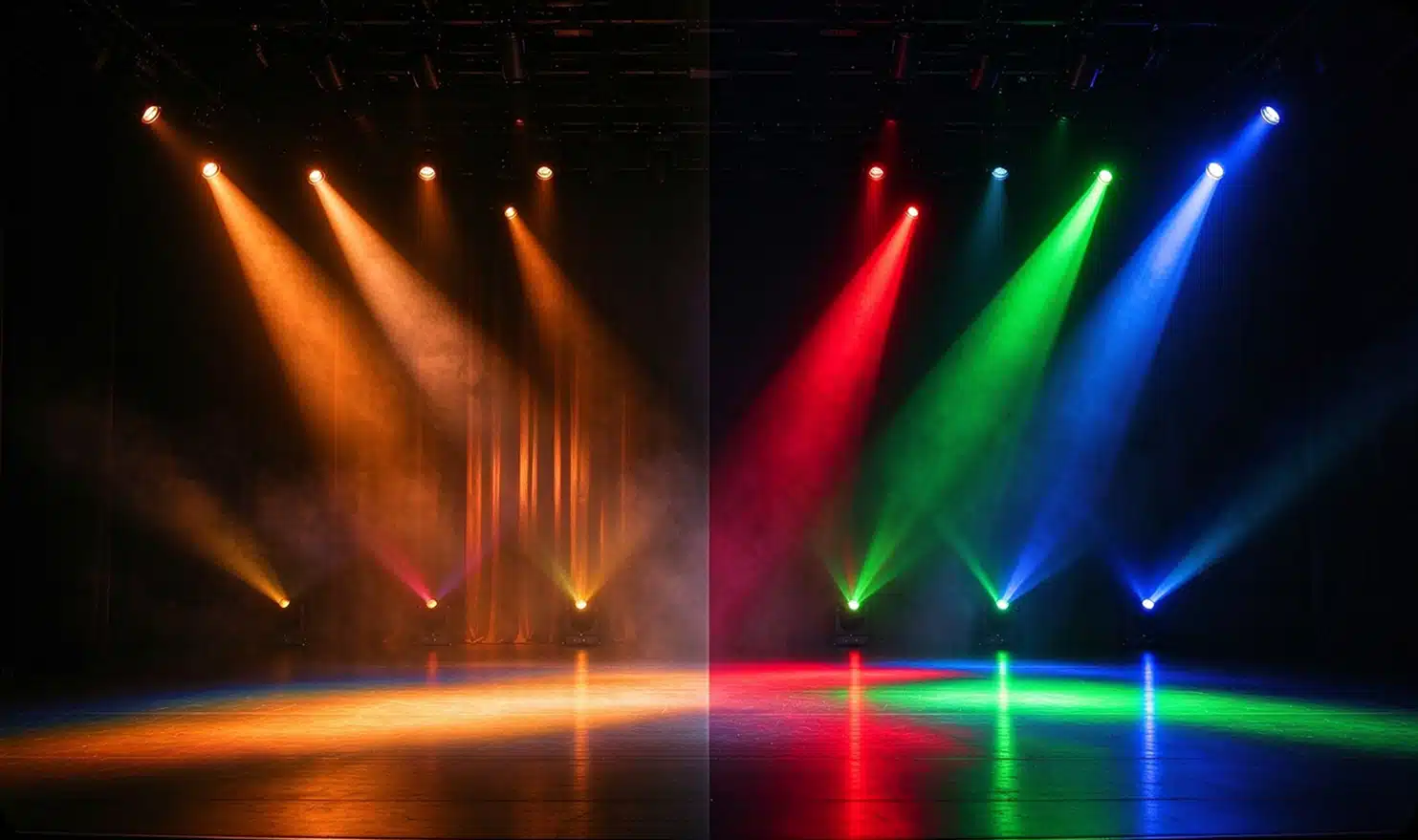
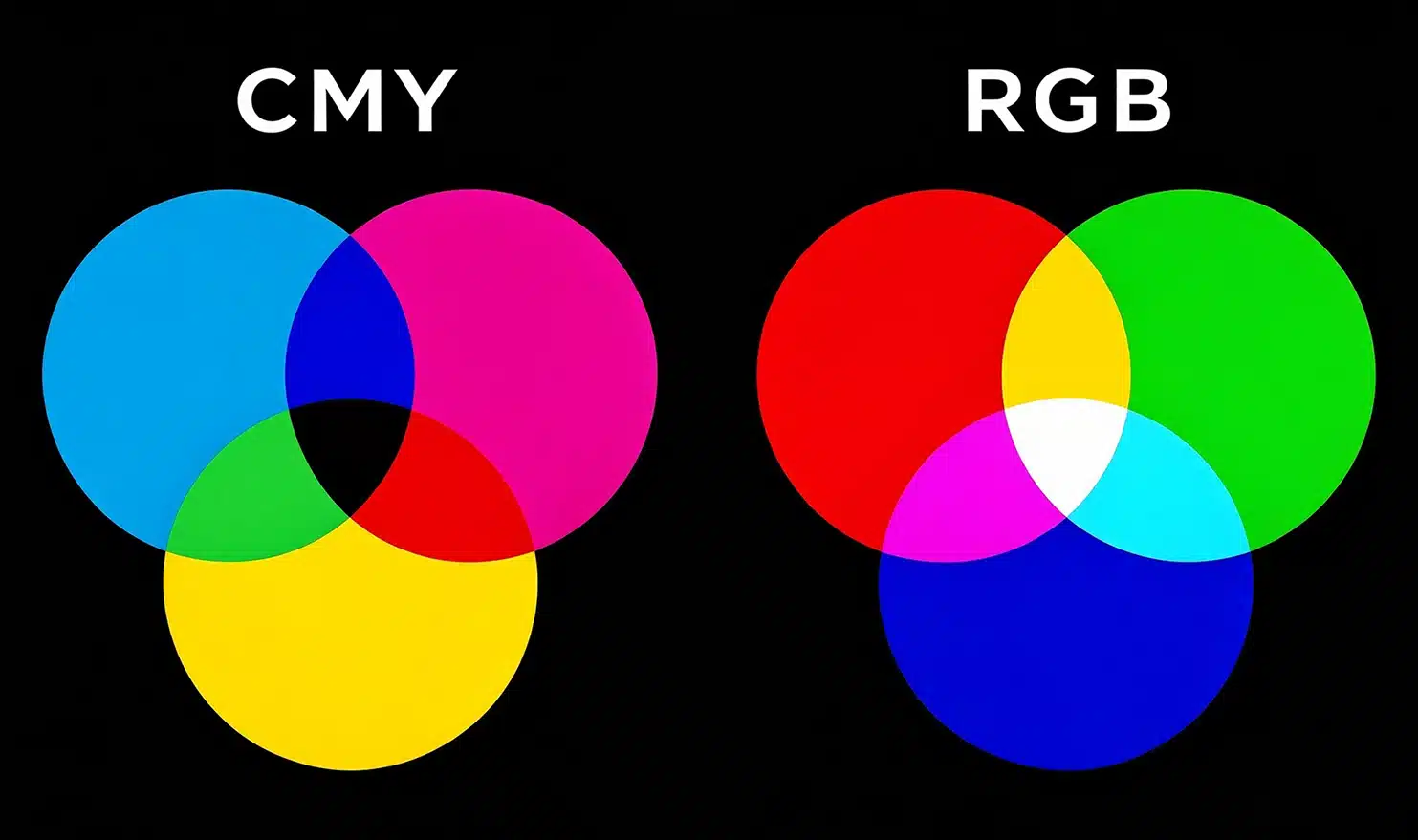
CMY systems deploy rotating cyan, magenta and yellow dichroic glass filter wheels. Incoming white light passes through these physical filters; each filter absorbs selected spectral bands and transmits the remainder. Target hues are created by overlapping two or three filters to “subtract” unwanted wavelengths — the mechanism of subtractive colour mixing.
Precise mechanical positioning of the glass flags yields a smooth, continuous spectral output. It renders deeply saturated colours alongside soft pastel shades, including natural amber and lifelike skin tones.
RGB (LED-based) — Additive Mixing
RGB mixing works via additive combination of discrete red, green and blue LED light sources. Equal intensity across all three primaries produces white light; varying intensity ratios generate target colours. All colour output is digitally governed via DMX control signals.
2. Key Performance Comparison
| Dimension | CMY Dichroic FliterWheel | RED LED Additive Mixing |
| Mixing Principle | Subtractive: light absorption via physical filters | Additive: optical summation of discrete LED primaries |
| Hardware | Mechanically actuated dichroic glass filter flags | R/G/B LED array, all-digital drive electronics |
| Colour Saturation | Excellent; delivers deep, highly-saturated hues | Moderate; performance drops for deep blues and violets |
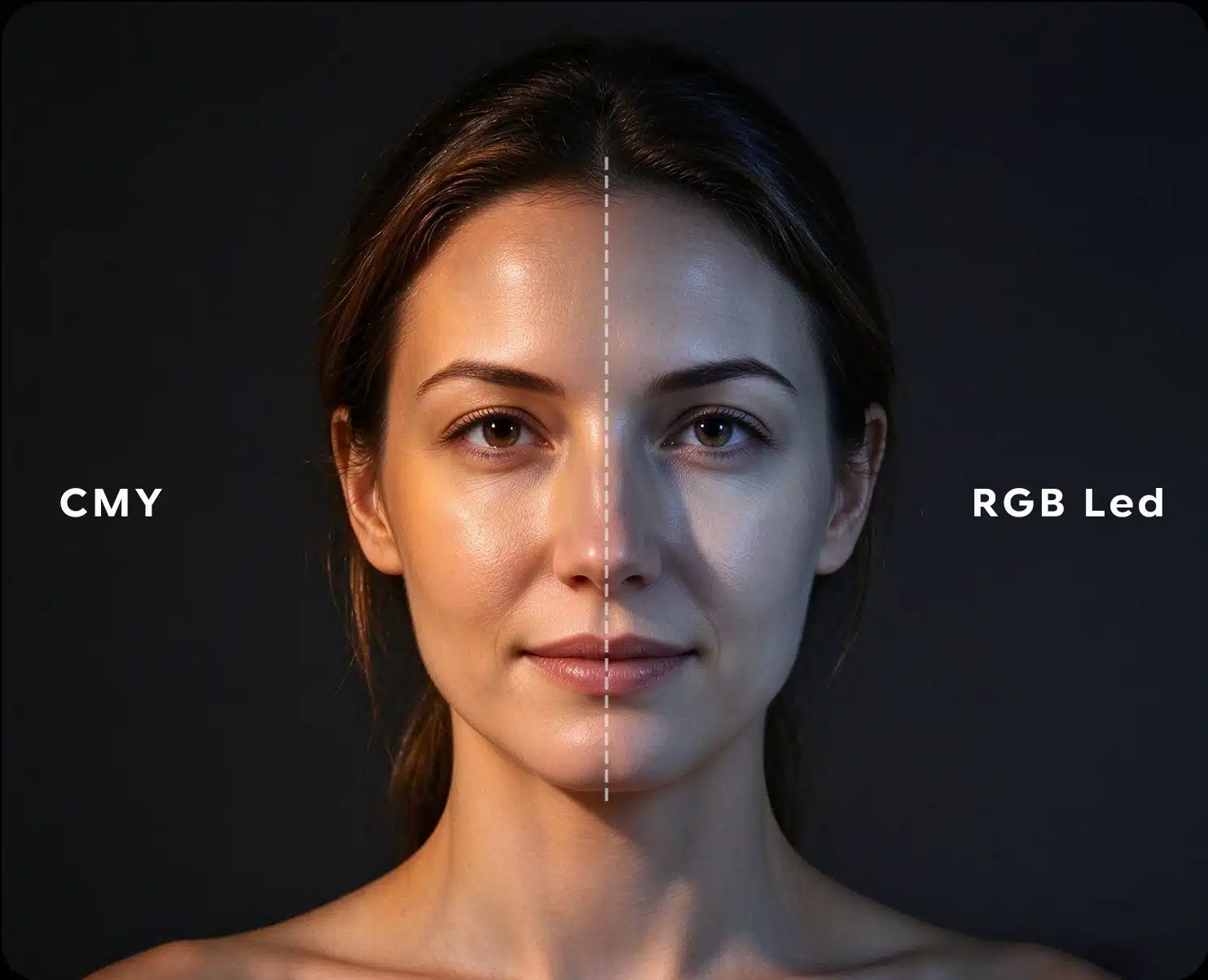
| Skin-tone & Warm Colours | Continuous spectrum; natural-looking warm tones and skin tones | Discrete segmented spectrum; warm tones risk grey/cyan cast |
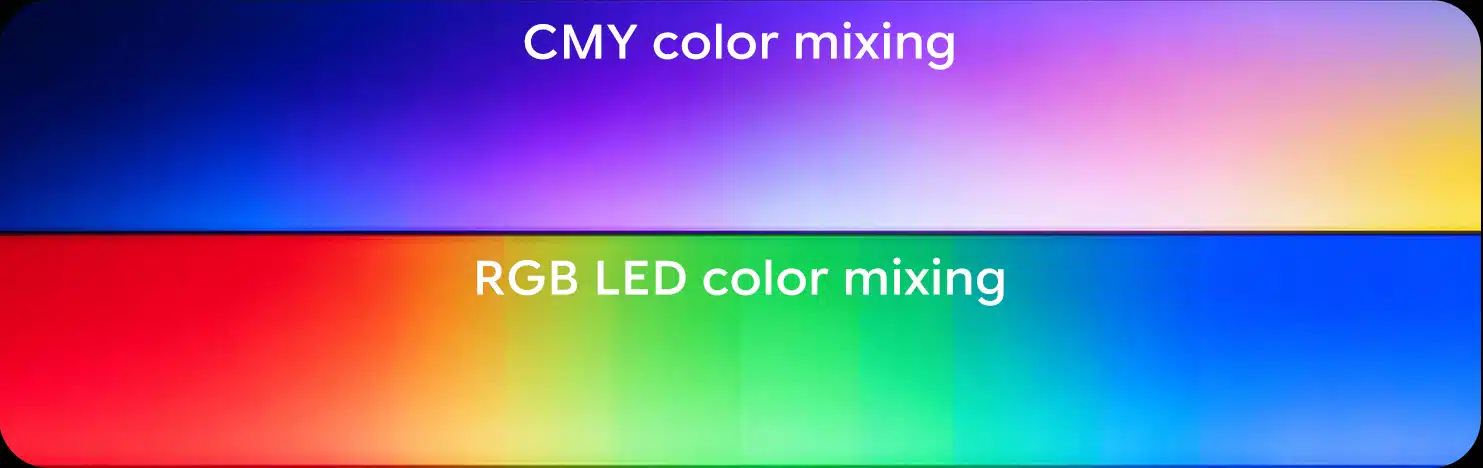
| Gradient & Transition | Ultra-smooth, seamless soft pastels achievable | Fast transitions, yet coarse intermediate colour steps |
| Control Behaviour | Mechanical positioning; moderate colour-change latency | DMX digital control; instant, repeatable colour shifts |
| Cost & Service Life | Higher capital cost; glass filters degrade under thermal load | Lower unit cost; long-lived LEDs with low heat draw |
| Primary Applications | Followspots, colour washing, talent close-ups, skin-critical lighting | Beam moving-heads, ambient stage washes, large-format colour effects |
3. Strengths & Limitations
CMY Filter-Wheel System:
Advantages
- Produces deeply saturated colours including rich deep blues and violets
- Continuous spectral output delivers authentic skin tones for talent and close-up work
- Exceptionally smooth colour transitions; renders subtle amber and pastel shades
- High colour fidelity comparable to conventional white-source illumination
Limitations
- Moving mechanical filter wheels; dichroic coatings age, fade or deform under high heat
- Physical movement introduces perceptible latency during colour changes
- Higher upfront hardware expense and ongoing maintenance overhead
RGB LED Mixing System:
Advantages
- Full digital DMX control: instant, reproducible colour recalls for programming
- Long LED service life, low power consumption and reduced thermal output
- Compact mechanical form factor, competitive unit pricing, well-suited to cue-based programming
- Broad gamut well-adapted for large-scale atmospheric colour washes
Limitations
- Compromised performance for certain saturated colours: deep blue, violet and orange-amber
- Segmented LED spectrum can cause grey or cyan discolouration on skin tones
- Visible stepping / banding within intermediate colour gradients
- Generally lower CRI; less-accurate white-light rendition versus CMY
4. Practical Identification: CMY vs RGB
You can rapidly differentiate the two lighting systems using these field checks:
- Hardware inspection: CMY fixtures contain rotating physical cyan-magenta-yellow glass filter flags. RGB units feature surface-mount R/G/B LED arrays with no moving colour filters.
- Optical output test: Project light onto a neutral white surface or human subject. CMY renders natural amber and skin tones. RGB output may exhibit a digital-style grey or cyan bias in warm shades.
- Observe colour ramping: CMY delivers seamless, fluid colour shifts. RGB often shows visible stepping across gradual fades.
- White-light assessment: CMY-generated white light maintains superior purity and colour fidelity. RGB-mixed white frequently carries subtle colour imbalance.
- Specification sheet review: Look for terms CMY colour mixing / dichroic colour wheel for filter-wheel units; RGB 3-in-1 LED / additive colour mixing denotes LED-based fixtures.

5. Production-oriented System Selection Guidance
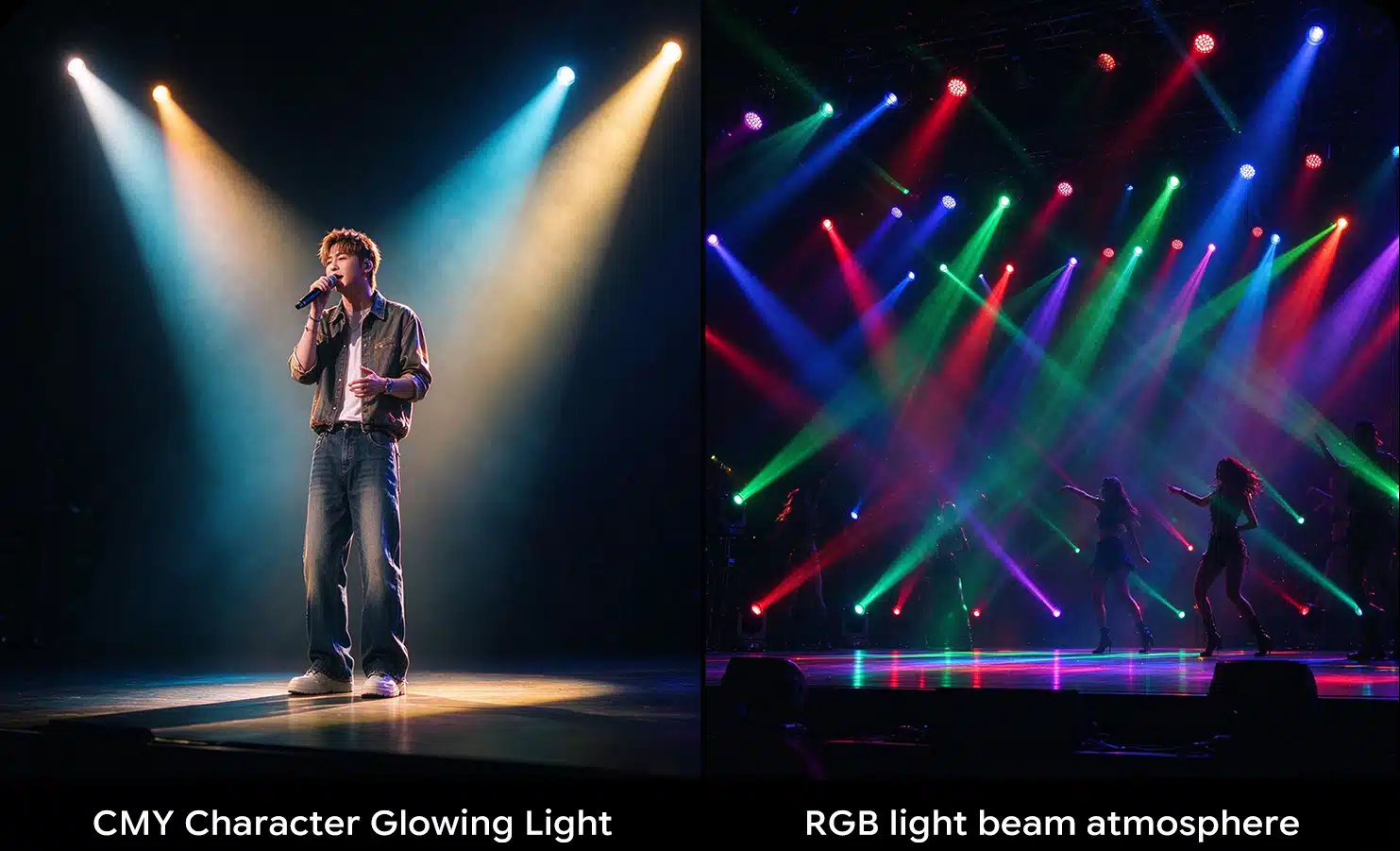
- Followspots, vocalists, on-talent close-ups, interviews: Prioritise CMY for authentic skin-tone reproduction and high-fidelity warm lighting.
- Moving-beam fixtures, nightclub and festival environments: Select RGB for instant colour changes, programmability and dynamic beam effects.
- General ambient colour washing: Both technologies are viable. Choose CMY for lush saturated colour; choose RGB for cost-efficiency and robustness for touring.
- Budget & operational profile: RGB suits constrained-budget or heavy-touring deployments. CMY is recommended for high-profile productions prioritising visual fidelity and human-subject lighting.
6. Application Philosophy
Deploy CMY when visual fidelity and texture are paramount
Ideal for opera, theatre, ballet, recitals, broadcast and high-end live events where realistic skin tones and subtle colour gradation define the visual narrative.
CMY delivers painter-like, textural lighting: natural complexions, nuanced warmth and seamless transitions. Audiences perceive mood and scene composition rather than overt artificial coloured-light artefacts.
Deploy RGB when dynamism and atmospheric impact take priority
Best-suited to concerts, electronic music events, festivals and club environments requiring rapid colour strobing, bold block-colour washes and high-energy beam work.
RGB delivers neon-like electronic vibrancy: punchy large-format colour fields and near-instant colour changes that emphasise rhythm and visual spectacle.
| In short: pick CMY to illuminate performers and craft nuanced imagery; pick RGB to generate crowd-moving energy and atmosphere. The two systems complement one another on a single stage: CMY serves principal talent and image quality, while RGB builds ambient dynamism. |