

LED PAR Light vs. Moving Head Beam Light: A Guide to Selection and Combination

When planning stage lighting for any event, LED PAR Lights and Moving Head Beam Lights are undoubtedly the two most essential tools in a lighting designer’s kit.
Think of them as a painter’s palette and brush: one provides the background colors, while the other defines the lines. A common question from first-time clients is: “Since they are both lights, can I just purchase one type?”
The answer is simple: To achieve an ideal visual effect, you need both. While both are lighting fixtures, treating them as interchangeable is like asking an artist to paint with only one color—the final result will lack depth.
Understanding their unique roles and how to combine them is the key to creating a professional, multi-layered visual experience within a limited budget.
I. Core Differences: LED PAR Light vs. Moving Head Beam Light
We can quickly understand the fundamental differences between these two fixtures through several key dimensions.
1. Light Characteristics and Function
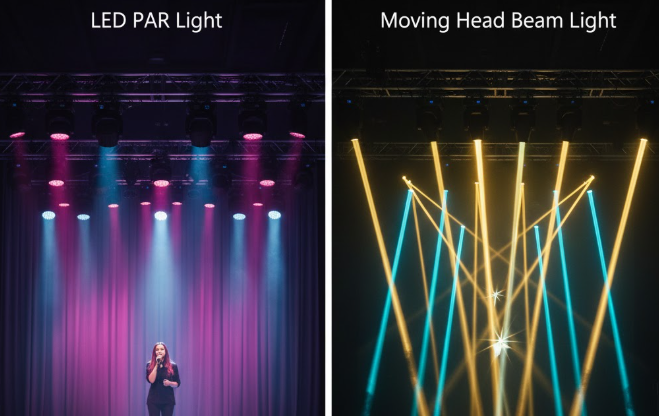
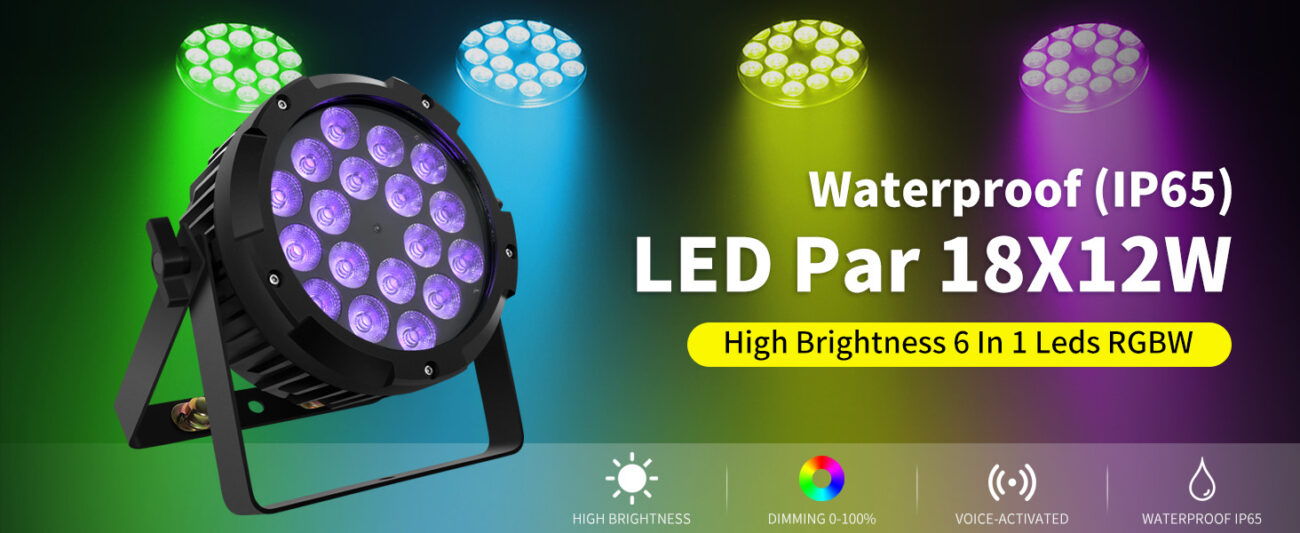
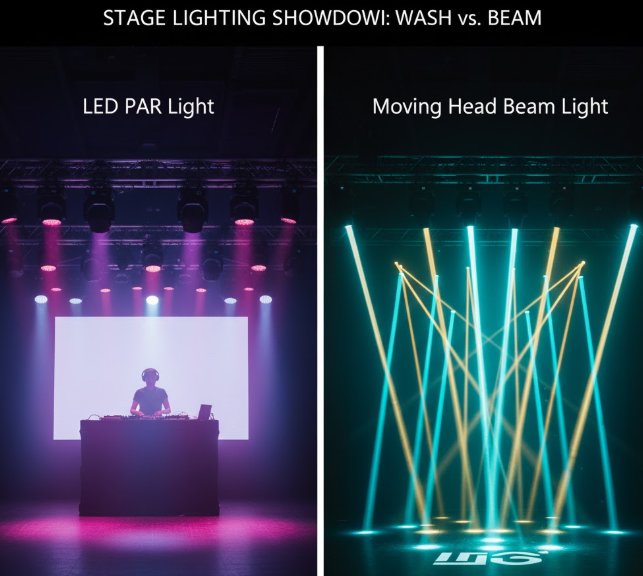
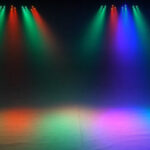
- LED PAR Light: Think of this as a “Surface Light Source.” It typically features a wide beam angle with soft, even light. It is ideal for large-area stage washing, providing soft front lighting for performers, or rendering the overall atmosphere. Its core mission is to create a visual foundation.
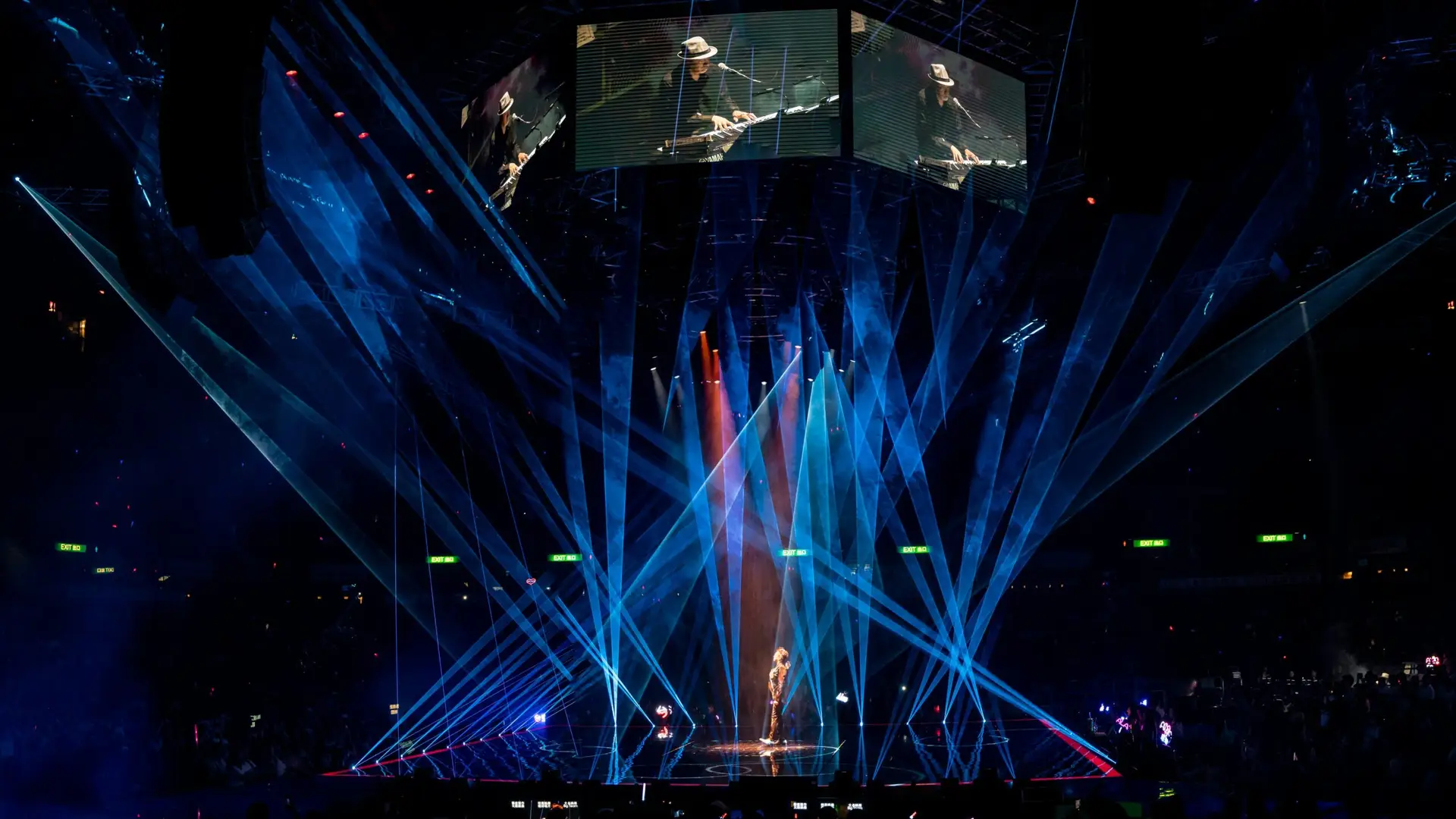
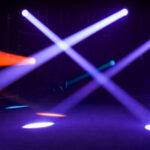
- Moving Head Beam Light: This is the ultimate “Point Light Source.” Utilizing a precision optical system, it compresses light into a sharp, highly penetrative pillar of light. Its charm lies in its dynamism—moving and cutting through the air in sync with the music to create ever-changing lines and geometric patterns.
2. Movement Capabilities
- LED PAR Light: Most are static fixtures. The projection angle is usually set during installation, focusing on static color rendering.
- Moving Head Beam Light: Movement is its core advantage. It features high-speed, wide-range rotation (Pan and Tilt), allowing for room-wide scanning, spotlighting, and complex aerial effects when combined with gobo wheels and prisms.
3. Comparison Table
| Feature | LED PAR Light | Moving Head Beam Light |
| Primary Role | Washing, Background color, Ambient light | Aerial dynamics, Visual focus |
| Beam Shape | Diffused, soft wash | Sharp, concentrated pillar |
| Installation Density | High (to create an even visual base) | Moderate (often in matrices/arrays) |
| Key Buying Points | Color Rendering Index (CRI), Color mixing uniformity | Brightness, Prism effects, Gobo clarity |
II. Combination Strategies
Great lighting design is about the balance between atmosphere and focus—the harmony of stillness and motion. Here are three classic strategies to elevate your stage presence:
Strategy 1: The Classic Match of Atmosphere and Focus (Best for Concerts, Live Houses)
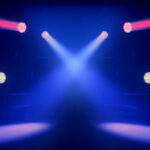
- Setup: Use a sufficient number of LED PARs to bathe the entire stage in a primary tone (e.g., deep blue) to build visual depth. Then, let the Moving Head Beams shoot high-contrast, sharp beams (e.g., bright golden yellow) to cut through and scan the blue space.
- Effect: The PARs create the canvas, and the Beams act as the brushes carving out dynamic textures. This contrast instantly grabs the audience’s attention.
Strategy 2: The Magic of Scene Switching (Best for Multi-function Halls, Ballrooms)
- Setup: In “Meeting Mode,” use only the white light of the LED PARs for bright, uniform illumination. When transitioning to “Performance Mode,” dim the PARs and activate the Moving Head Beams to utilize their strobes and moving patterns to ignite the atmosphere.
- Effect: A seamless one-click transition from a serious professional environment to a high-energy performance stage.
Strategy 3: Integration of Brand and Vision (Best for Product Launches, High-end Events)
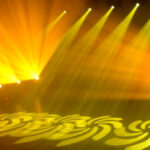
- Setup: Use LED PARs for uniform “wall washing” on the background or curtains to create a clean color backdrop. Simultaneously, use the Gobo function of the Moving Head Beams to project a crisp corporate logo or event theme onto that colored background.
- Effect: This “figure-ground” relationship makes brand information stand out elegantly, providing a high-impact visual signature.
III. LED PAR Light vs. Moving Head Beam Light:Considerations for Purchasing and Customization
- For LED PARs: Focus on CRIIf you are using lights for filming, live streaming, or high-end meetings, ensure you choose LEDs with a high Color Rendering Index (CRI > 95,). LEDs are commonly used as an important component in LED walls. Low CRI lighting makes skin tones appear pale or unnatural on camera.
- For Beams: Create Unique Visuals with Prisms and GobosA good beam light isn’t just bright; it needs excellent prism effects (like 8 or 16-facet prisms) and gobo clarity. We can also provide customized Gobos so your brand logo becomes a unique visual signature for every event.
- Compatibility and Control: Ensure Seamless SyncEnsure all fixtures support the standard DMX512 protocol. A reliable supplier will guarantee that all equipment has undergone integrated testing to ensure color transitions and movements are perfectly synchronized.
Conclusion
Simply put, LED PAR lights are the “flesh and blood” of the stage atmosphere, determining the tone and color; Moving Head Beams are the “skeleton,” defining the motion and rhythm of the space. Only by scientifically configuring both can you ensure every cent of your investment delivers maximum value.
One thought on “LED PAR Light vs. Moving Head Beam Light: A Guide to Selection and Combination”