

Stage Lighting Maintenance Manual: 6 Core Secrets to Extending Fixture Lifespan

For a professional stage lighting system, purchasing the equipment is only the beginning. The true realization of value and the guarantee of performance quality lie in consistent, professional daily Stage Lighting maintenance.
A well-maintained lighting rig not only delivers every beam in its peak state but can also extend its service life by 30% to 50%, preventing massive losses caused by equipment failure.
This manual reveals 6 core secrets to extending the life of your fixtures, helping you reduce operating costs and ensure every performance is flawless.
Stage Lighting Maintenance: Quick Checklist
| Focus Area | Action Required | Frequency / Note |
| 1. Dusting | Clean vents, fans, and heat sinks with compressed air. | Quarterly or after big shows. |
| 2. Optics | Wipe lenses with 99% alcohol and lint-free swabs. | Never touch with bare hands. |
| 3. Mechanics | Check belts for cracks; apply high-temp silicone grease. | No generic oils or butter. |
| 4. Power Cycle | On: Console → Fixture. Off: Lamp off → Cool 10m → Power off. | Avoid rapid on/off switching. |
| 5. Voltage | Use voltage regulators; check for tight wiring terminals. | Prevents circuit burnouts. |
| 6. Idle Care | Run fixtures for 1–2 hours if the venue is closed. | Once a week to expel moisture. |
1. Stage Lighting Maintenance: Regular Dusting
Stage fixtures, especially complex moving heads, generate significant heat during operation. To dissipate this heat, internal fans draw in air—along with dust and smoke particles.
- Potential Risks: Dust buildup on color wheels, gobos, and internal optics reduces light output and causes color shifts. More critically, it can clog cooling channels, leading to overheating and damage to key components.
- Maintenance Tip: We recommend a thorough internal cleaning with dry, clean compressed air every quarter or after major productions. Focus on vents, fan blades, and heat sinks to ensure unobstructed airflow.
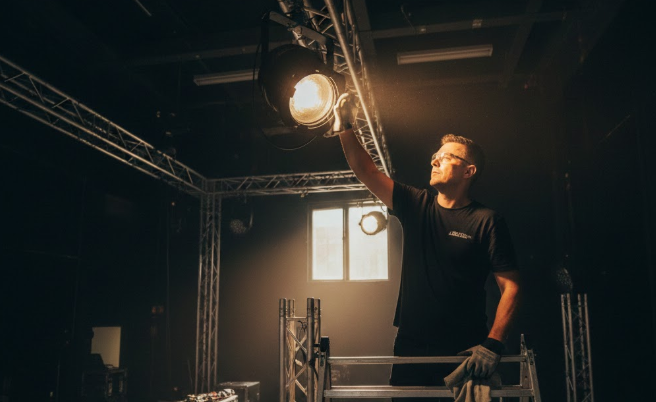
2. Optical System Care: Professional Grooming for the “Eyes”
Lenses and reflectors are the “eyes” of the light. Their cleanliness and light transmission directly determine beam quality and visual impact.
- Prohibited Action: Never touch lenses with bare hands! Oils and moisture from fingers will bake onto the lens coating under high operating temperatures, causing permanent, irreparable damage.
- Correct Method: Use professional lens tissues or lint-free swabs dipped in high-purity alcohol (99%+). Gently wipe in a spiral motion from the center outward.
3. Mechanical Inspection: Ensuring Smooth Motion
The Pan/Tilt movement and gobo rotation of moving heads rely on precision belt and gear drive systems.
- Key Focus: Periodically check drive belts for signs of aging, cracking, or slack. Ensure gears mesh smoothly without debris interference. Quiet, fluid operation is the hallmark of a healthy mechanical system.
- Lubrication Note: Fixtures are typically treated with high-temperature grease at the factory. If replenishment is needed, only use specialized high-temperature silicone grease. Avoid generic grease or machine oil, as they can melt and drip at high temperatures, risking circuit board contamination and short circuits.
4. Follow Proper Power Sequencing
Many fixture failures occur during the moment of power-on or power-off, particularly for units using traditional discharge lamps and ballasts.
- Core Sequence:
- Power On: Start the lighting console first, then power up the fixtures individually.
- Power Off: Turn off the light source (douse the lamp) via the console first. Allow the fans to run for 5–10 minutes for sufficient cooling before disconnecting the main power.
- Warning: Avoid frequent, rapid power cycling. This creates massive electrical surges that significantly shorten the lifespan of bulbs, LEDs, and internal power modules.
5. Monitor and Stabilize Working Voltage
Professional stage lighting equipment operates like precision instruments and requires high voltage stability.
- Potential Risks: Over-voltage can instantly fry drive circuits; under-voltage may cause motor step loss, inaccurate positioning, color drifting, or spontaneous reboots.
- Solutions: For large-scale management, we strongly recommend dedicated voltage regulators or online UPS systems. During routine checks, ensure distribution cabinet terminals are tight and free of oxidation.
6. Stage Lighting Maintenance: Avoid Damp Environments and Long Idle Periods
Precision electronic components are highly sensitive to humidity. Idle equipment is often more prone to failure.
- Moisture Prevention: If a venue is closed for over a week, schedule a weekly “warm-up.” Power on and run all fixtures for 1–2 hours. The heat generated by the fixture effectively drives out internal moisture, preventing oxidation or short circuits on circuit boards.
Specialized Maintenance Checklist
| Fixture Type | Critical Focus | Key Maintenance Action |
| Moving Heads | Mechanical Calibration | Recalibrate Pan/Tilt sensors & tighten drive belts. |
| LED Wash/Pars | Thermal Management | Deep clean fan intake; check for “dead” LED pixels. |
| Laser Lights | Optical Path | Clean aperture glass with specialized lens paper only. |
| Battery Up-lights | Battery Health | Charge/discharge every 3 months during storage. |
| Fog/Haze Machines | Fluid System | Flush with distilled water/cleaner to prevent clogs. |
| Follow Spots | Manual Controls | Lubricate sliding focus rails & iris diaphragms. |
Conclusion: Maintenance is an Investment, Not a Cost
Integrating these 6 secrets into your workflow will significantly reduce failure rates and keep your gear “performance-ready.” Excellent maintenance is the best return on your investment.
Our Professional Support & Service Commitment:
As a professional stage lighting solution provider, we offer support that goes beyond the product:
- Warranty: All light products come with a 2-year free repair warranty.
- Returns: 7-day no-reason returns are available for non-customized products (overseas shipping costs to be borne by the buyer).
- Support: Online remote debugging, video guidance, and on-site maintenance (international service available).
Encountering maintenance challenges?
If you have questions or require complex repairs, click [Online Support] to contact us. Our senior engineering team is ready to provide free remote technical guidance!