
Common Pitfalls in Stage Lighting Procurement 2026: The Ultimate Buyer’s Guide

When purchasing stage lighting, many buyers are easily misled by parameters and aesthetics. While industrial design can be replicated at a low cost, the real indicators of quality lie in the number of coating layers on the optical lenses and the redundancy design of the PCB.
To help you avoid these hidden procurement costs and future risks, I have summarized the following nine core procurement pitfalls:
Pitfall 1 in Stage Lighting Procurement 2026: Focusing Only on “Power” While Ignoring Actual Luminous Efficacy
Many believe that choosing a high-power stage light guarantees higher brightness—a common view for household appliances. However, for stage lighting, this is the easiest trap for beginners to fall into because the logic is entirely different.
In the LED era, Power represents electricity consumption, while Lumen or Lux represents actual brightness. Power data is difficult to fake, whereas measuring luminous efficacy requires extremely expensive integrating spheres or goniophotometers. Since the human eye cannot easily distinguish subtle differences, many buyers rely on “Power” figures for psychological comfort.
- The Gimmick: Inferior stage lighting manufacturers use low-efficacy LEDs or cheap, oversized, outdated chips to boost brightness. Although power increases, it generates excessive heat. Due to poor heat dissipation and low-quality lenses, the actual brightness is often lower than high-quality, lower-power lights.
- Guide: Look beyond power. Ask for optical test reports (IES files) and pay close attention to the Center Illuminance (Lux).
Pitfall 2: Assuming “Identical Housing” Means Identical Quality
“Public molds” are rampant in the industry. Two moving heads may look identical on the outside but have a world of difference in price. The truth is: Appearance does not determine everything. The core differences lie in the internal motherboard, motors, and cooling components.
- Motherboard: High-quality motherboards feature isolation protection to prevent high-voltage surges from frying the chips. They are also coated with a glossy “conformal coating” for protection against moisture, dust, and salt spray. Furthermore, using top-tier cylindrical capacitors like Rubycon or NCC indicates superior quality.
- Motors: Three-phase motors are faster, quieter, and more precise, typically featuring 3 or 4 output wires. Their performance is worlds apart from ordinary motors.
- Heat Dissipation: Densely packed, thick cooling fins and silent fans determine whether the light will experience color shifts after a year of use.
- Guide: Disassemble the unit to compare internal wiring, motor brands, and the cooling structure. Never judge by the exterior alone.
Pitfall 3: Considering Only Price While Ignoring “Maintenance Costs”
Buying a light that is 20% cheaper may seem like a deal, but the long-term risks are enormous.
- The Truth: Stage lights are precision electromechanical devices. Reliability is paramount. Inferior lights often suffer from stepper motor “step loss,” broken belts, and noisy fans. These problems surface during long-term use, and the cost of replacement is extremely high.
- Guide: Inquire about the expected lifespan and quality of the power supply, LEDs, and belts.
Pitfall 4: Blindly Trusting “Certificates” Without Checking “Consistency”
Some factories display a full set of CE/UL/3C certificates at exhibitions, but this does not guarantee the goods you receive are compliant. You must ensure the mass-produced products match the sample quality.
- The Truth: The “Certified Model” is not always the “Shipped Model.” Some stage lighting manufacturers submit a “high-spec” version for testing but switch to low-cost wiring during mass production to save costs.
- Guide: During a factory visit, randomly inspect products on the production line and compare internal components with the specifications recorded in the certificates.
Pitfall 5: Overlooking the Role of “Thermal Design”
Many buyers evaluate the color accuracy of a light and buy it immediately if it looks good. However, after six months, the “white light turns yellow.” This is usually due to poor thermal design.
- The Truth: Inadequate heat dissipation directly affects device lifespan and leads to irreversible lumen depreciation (light decay) of the LEDs.
- Guide: Ask the stage lighting manufacturer about their control standards for “Junction Temperature.”
Pitfall 6: Being Misled by the “Silent Fan” Concept
To ensure performance quality, buyers for theaters and studios prioritize silence. However, do not just take a manufacturer’s word for “ultra-quiet.”
- The Truth: True silence depends not just on the fan, but on intelligent temperature-controlled speed regulation. Some lights simply lower the fan speed, causing internal heat to rise. While quiet, the LEDs age rapidly.
- Guide: Ask if the cooling mechanism is “Always On” or “Linear Regulation.” Check if the light offers a “Silent Mode” switch.
Pitfall 7: Ignoring Compatibility Between DMX and RDM Protocols
Many buyers assume any DMX port will work, only to find they cannot change address codes remotely on-site.
- The Truth: Many cheap factories claim to support RDM but can only read voltage. Real RDM should allow you to modify DMX addresses, monitor LED temperature, and receive error codes remotely from the console.
- Guide: Connect multiple lights to a console on-site to test RDM feedback and ensure remote address modification is supported.
Pitfall 8: Misjudging “Color Rendering Index (CRI/Ra)” vs. “TLCI”
Beginners often focus solely on CRI. However, for high-definition video or high-end portrait lighting, Ra > 90 may not be enough.
- The Truth: Ra is for the human eye; TLCI is for the camera. Many LEDs look “rosy” to the eye but appear green through a camera lens, significantly increasing post-production color correction costs.
- Guide: For film, broadcast, or studio lighting, check the Spectral Power Distribution (SPD) and ensure TLCI > 95.
Pitfall 9: Focusing Only on “LED Brand” and Ignoring “Drive Current”
Manufacturers often boast: “My lights use Osram LEDs.” While good LEDs are a sign of quality, they are not the only standard.
- The Truth: Even with good LEDs, the lifespan can be compromised by other factors. To make lights appear brighter, some manufacturers increase the motherboard output current, resulting in “overclocking.” This leads to rapid light decay, flickering, or total burnout.
- Guide: When visiting a factory, test the actual current output from the driver board to the LED board to see if it stays within the safe rated range specified in the LED datasheet.
How to Lock in “Cost-Effective” Lighting Fixtures from Thousands of Global Suppliers?
Faced with endless procurement pitfalls, you need a long-term partner that offers both high cost-performance and professional quality.
As a representative brand of cost-effective professional lighting, DJclub has been committed to breaking the stereotype that “high quality must come at a high price” since its founding in 2015.
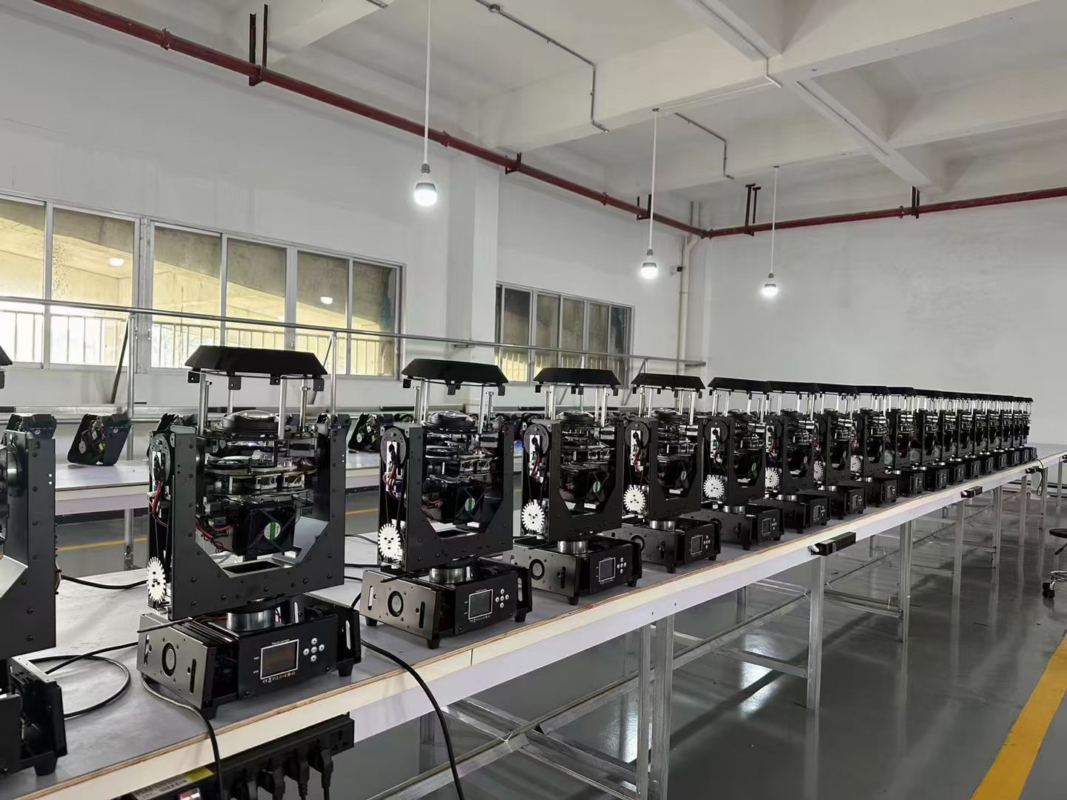
Its modern manufacturing base of over 5,000 square meters is equipped with fully automatic production lines and an extremely strict QC quality control system.
More than 5,000 sets of equipment roll off the production line each month, all with excellent consistency.
Why is DJclub the top choice for overseas and high-standard projects?
- 100% Globally Compliant: All Beam Lights, LED Par Lights, and Zoom Lights series have obtained authoritative CE and RoHS certifications, fully complying with EU and US safety access standards.
- Extreme ROI: While maintaining industrial-grade performance, costs are optimized through large-scale production — affordable prices with reliable quality.
- Full-Scene Coverage: DJclub provides one-stop stage visual solutions.
Want to get the latest 2026 price list from DJclub?
👉 [Click here to contact our procurement specialists / visit the official website for details]
More Related Articles
- Guide to China Stage Lighting Manufacturers & Sourcing Bases
- Lighting Solutions for Outdoor Immersive Shows: Beating Extreme Weather
- Customized Lighting for Bars and Nightclubs: Creating the Ultimate Atmosphere
Custom Stage Lighting vs. Off-the-Shelf Fixtures: Which is Right for You?
Multi-Function Hall Stage Lighting Configuration: A Versatile Solution Guide
LED Par Light vs. Moving Head Beam Light: Selection and Combination Guide
Mastering Your Stage Lighting Budget: 5 Sourcing Pitfalls to Avoid
Stage Lighting Maintenance Manual: 6 Secrets to Extending Fixture Lifespan
Nightclub Stage Lighting Buying Guide: How to Save 30% on Your Budget
2026 Guide to Finding Stage Lighting Factories: Secure Direct Factory Pricing